Rust edition: this page follows the live DeepWiki structure but treats the current Rust crates as implementation authority. Non-Rust surfaces are identified at their boundary and are not presented as Rust APIs.
Execution System
Relevant Rust source files
crates/execution/src/engine/mod.rscrates/execution/src/client/mod.rscrates/execution/src/matching_engine/mod.rscrates/execution/src/reconciliation/mod.rs
Overview
The Execution System processes trading orders from strategy submission through risk validation, emulation, and venue routing. This system manages the full order lifecycle, including position accounting, state persistence, and reconciliation with external venues. It is designed for high-performance, asynchronous operations, utilizing both Rust implementations for critical components.
Sub-pages:
- ExecutionEngine Architecture — Order lifecycle management, client routing, and position updates.
- RiskEngine and Pre-trade Checks — Pre-trade validation, notional limits, and rate limiting via throttlers.
- OrderEmulator and Complex Orders — Local stop orders, trailing stops, and matching core triggers.
- Execution Algorithms — Automated execution frameworks (TWAP, VWAP, etc.) and custom implementations.
- Contingent Orders and Order Manager — OTO/OCO order management and command routing patterns.
System Architecture
The execution system routes TradingCommand messages through specialized components via the MessageBus. Each component handles a specific stage of order processing, from high-level strategy logic to low-level venue communication.
Component Mapping
| Component | Primary Implementation | Key Methods/Fields |
|---|---|---|
Strategy |
submit_order(), _manager: OrderManager |
|
OrderManager |
cache_submit_order_command(), OrderManagerAction |
|
ExecAlgorithm |
on_order_event(), submit_order() |
|
RiskEngine |
execute(), _handle_submit_order() |
|
ExecutionEngine |
execute(), routing_map: HashMap<Venue, ClientId> |
|
ExecutionClient |
submit_order(), modify_order(), cancel_order() |
Execution Pipeline Diagram
Diagram — Order Execution Pipeline with Code Entity Mapping
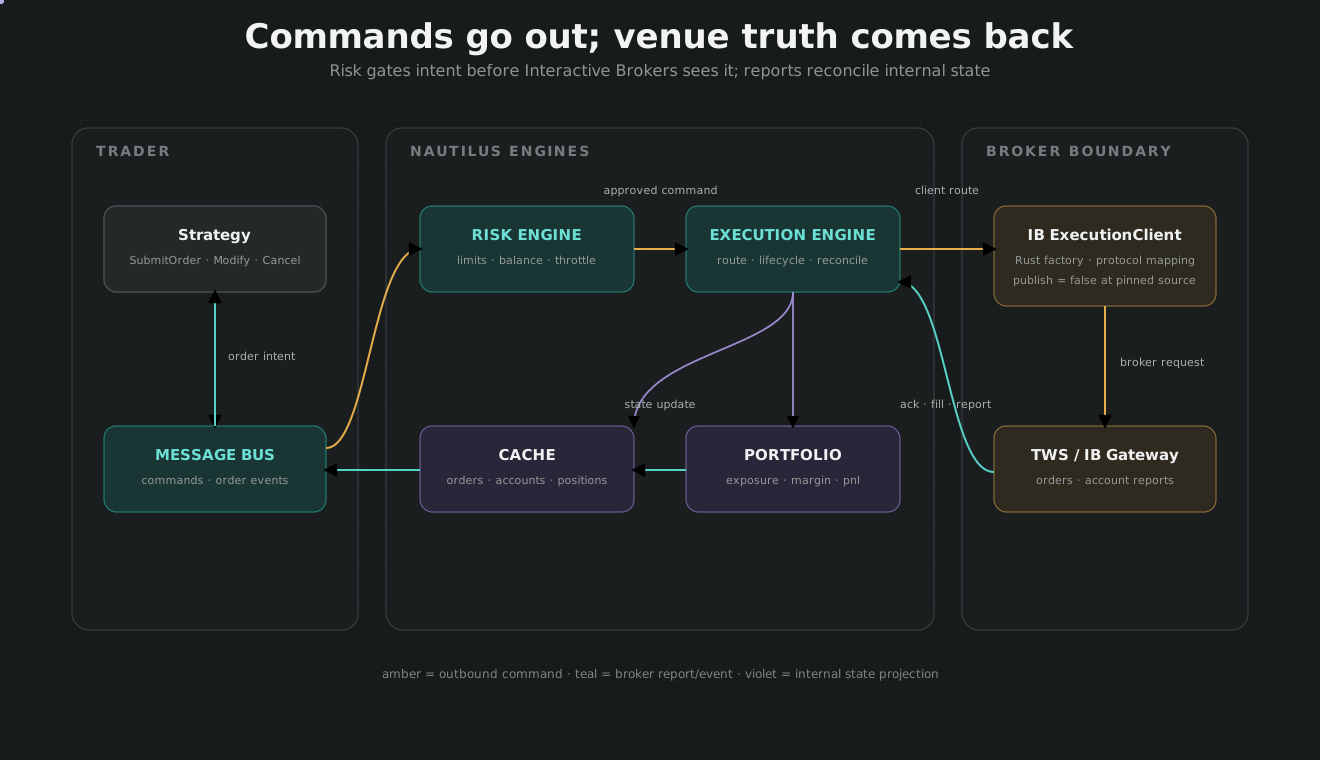
Emulation and execution algorithms may transform a strategy command before the risk boundary, but they do not bypass it. The selected broker adapter implements the standard Rust data and execution client factory contracts; it does not become the order, account, or portfolio model.
Sources:
Command and Event Flow
The execution system is entirely asynchronous, relying on TradingCommand subclasses (like SubmitOrder, ModifyOrder, CancelOrder) for requests and OrderEvent subclasses for state updates.
Command Flow Sequence
The outbound amber path in the figure is conditional: a denied command becomes an OrderDenied event and never reaches the execution client. An approved command is routed by venue or configured client identity and submitted through the client contract.
Sources:
Event Flow Sequence (Fills and Positions)
The returning teal path represents venue truth: acknowledgements, fills, cancellations, and generated reconciliation reports enter ExecutionEngine, update cached order state and portfolio projections, then publish typed events to interested strategies and actors.
Sources:
Core Components
Strategy Trading Commands
The Strategy base class provides the primary interface for initiating execution. Commands are routed through an internal OrderManager.
| Method | Implementation Behavior |
|---|---|
submit_order |
Submits a single order for execution. |
submit_order_list |
Submits a list of orders (e.g., OCO/OTO). |
modify_order |
Modifies an existing order's price or quantity. |
cancel_order |
Requests cancellation of an order. |
Sources:
RiskEngine Validation
The RiskEngine performs pre-trade checks and rate limiting via the Throttler
- Throttling: Separate throttlers for submission and modification rates
- Trading States: Supports
ACTIVE,REDUCING, andHALTEDstates - Checks: Validates order price, quantity, notional value, and account balances
- Denial Reasons: Standardized codes like
NOTIONAL_EXCEEDS_FREE_BALANCEorRATE_LIMIT_EXCEEDED
Sources:
ExecutionEngine Orchestration
The Rust ExecutionEngine manages multiple ExecutionClient instances and maps them to venues.
- Routing: Uses
routing_map(Venue to Client) anddefault_client - OMS Support: Handles both
NETTINGandHEDGINGposition management - Reconciliation: Includes logic for inferred fills and external order status generation
- Snapshots: Periodic snapshots of positions and orders for persistence
Sources:
Position Management
Position updates are driven by fills. The system determines the appropriate PositionId based on the strategy's OmsType.
| OmsType | Logic | ID Format |
|---|---|---|
NETTING |
Single position per strategy/instrument | {instrument_id}-{strategy_id} |
HEDGING |
Multiple positions per instrument | Unique ID from PositionIdGenerator |
The Portfolio component tracks these positions and updates PnL calculations based on market data events It utilizes an AccountsManager to handle balance updates across cash and margin accounts
Sources:
External Order Claims
Strategies can "claim" orders that were not originated by the platform (e.g., manual trades on the exchange UI).
- Claims are registered in
ExecutionEngine.external_order_claims - This is critical for reconciliation in live environments where external clients might interact with the same account
Sources: