Rust edition: this page follows the live DeepWiki structure but treats the current Rust crates as implementation authority. Non-Rust surfaces are identified at their boundary and are not presented as Rust APIs.
Glossary
Relevant Rust source files
crates/risk/src/lib.rscrates/persistence/src/lib.rs
This glossary defines codebase-specific terms, jargon, and domain concepts used throughout NautilusTrader. It serves as a technical reference for onboarding engineers to understand the mapping between high-level trading concepts and their specific implementations in the Rust hybrid architecture.
System Architecture Terms
NautilusKernel
The central dependency injection container and orchestration object. It is responsible for initializing and holding references to core engines (Data, Execution, Risk) and infrastructure components (MessageBus, Cache, Clock).
- Implementation:
NautilusKernelin - Role: Acts as the "glue" that allows components to discover each other during the
buildphase of aTradingNodeorBacktestNode.
MessageBus
The event-driven communication backbone of the platform. It supports a pub/sub pattern for distributing market data, order events, and system commands across components.
- Implementation:
MessageBusdefined in - Data Flow: Uses topic-based routing to ensure that components like the
ExecutionEngineonly receive relevantTradingCommandmessages. Recent improvements includecorrelation_idpropagation for request tracing - Serialization: Supports SBE and Cap'n Proto encodings for Rust-native publishers
Actor
A specialized component capable of publishing and subscribing to the MessageBus. Most user-defined logic, including strategies and data processors, inherits from this class.
- Implementation:
Actorbase class logic andDataActorCorein - Lifecycle: Follows the standard component state machine (PRE_INITIALIZED → READY → RUNNING → STOPPED → DISPOSED).
- Rust Plugins: Actors can now be loaded as separately compiled Rust cdylibs via the
PluginActortrait and thenautilus_plugin!macro
Component State Machine
A formal finite state machine (FSM) that governs the lifecycle of all major system entities.
| State | Description |
|---|---|
PRE_INITIALIZED |
The initial state upon instantiation. |
READY |
Component has been wired with dependencies and is ready to start. |
RUNNING |
The component is actively processing events. |
STOPPED |
The component has been gracefully shut down. |
DISPOSED |
Resources have been released. |
- Implementation:
ComponentStateenum in
Trading & Domain Concepts
OMS Type (Order Management System)
Determines how the ExecutionEngine tracks and aggregates positions for a strategy.
- HEDGING: Each trade can create a distinct position; multiple positions can exist for the same instrument simultaneously.
- NETTING: All trades for an instrument are collapsed into a single net position. The position ID naming convention is typically
{instrument_id}-{strategy_id}. - Position Snapshots: The system supports netting OMS position snapshotting for state recovery.
Fixed-Point Precision
NautilusTrader avoids floating-point errors by using fixed-point arithmetic for prices, quantities, and money.
- Standard Precision: 64-bit integers with 9 decimal places.
- High-Precision Mode: 128-bit integers with 16 decimal places (unavailable on Windows)
- Implementation: Managed via
PriceandQuantitytypes innautilus-model. Recent updates added checked mantissa/exponent constructors
Instrument
A financial contract or asset that can be traded. Nautilus supports a wide hierarchy including CurrencyPair, Equity, Futures, Option, and BettingInstrument.
- New Types:
CryptoFuturesSpreadandCryptoOptionSpreadhave been added to mirror contract sizing for combos - Symbology:
InstrumentIdserves as the unique identifier across the system. - Lookup: The system provides typed errors for missing lookups:
CurrencyLookupError,InstrumentLookupError, andOrderLookupError
Order Emulator
A local component that simulates exchange behavior for conditional orders (like Stop-Loss or Trailing-Stops) that are not natively supported by a specific venue's API. It utilizes the MatchingCore for deterministic trigger logic.
Natural Language to Code Entity Mapping
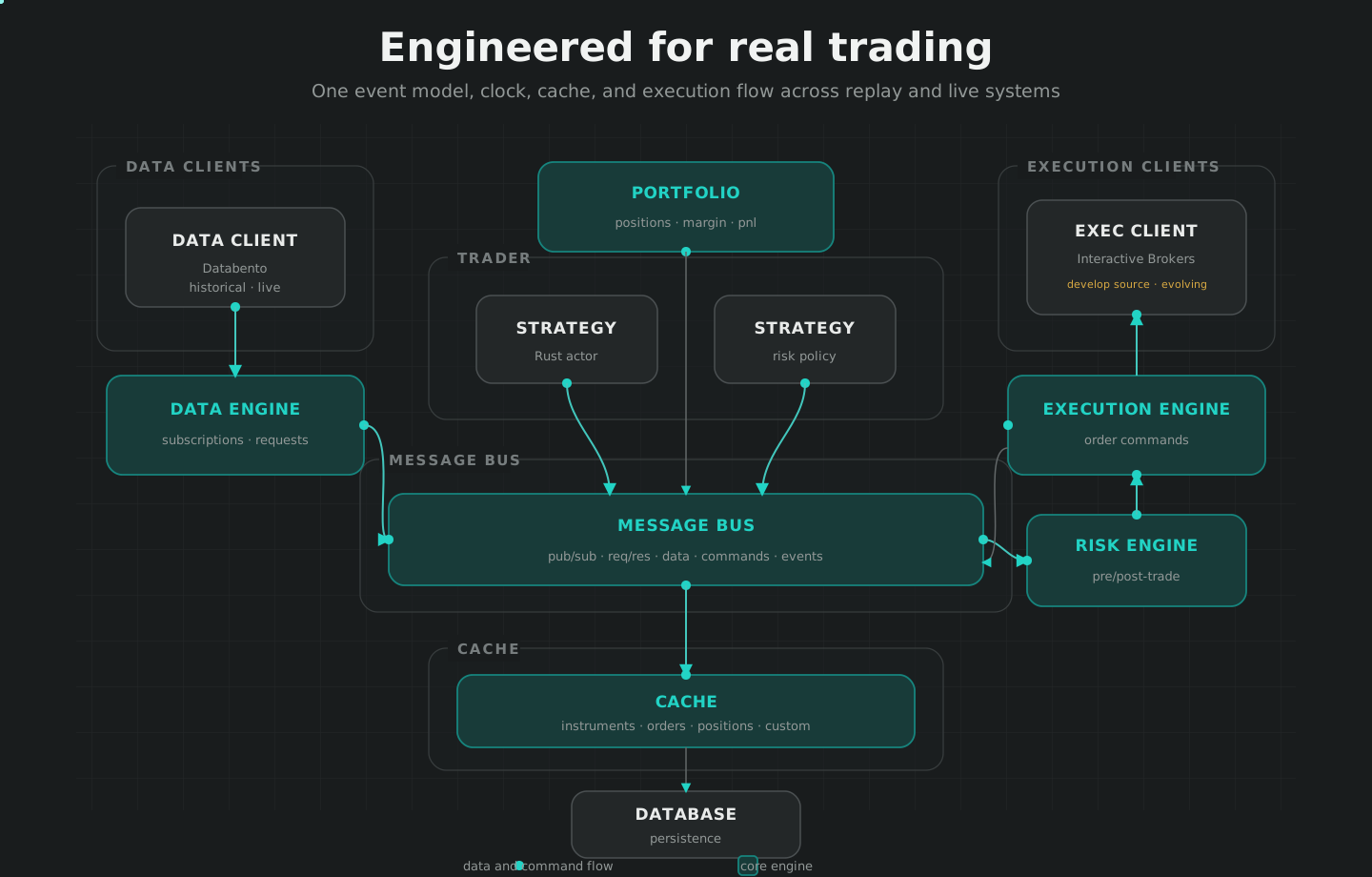
The following diagram bridges domain concepts to their specific class implementations within the codebase.
Domain to Code Entity Space
Execution & Simulation Terms
MatchingCore
The low-level Rust-based matching logic used by both the BacktestEngine and the OrderEmulator. It handles the deterministic matching of orders against price updates.
FillModel
A set of rules used during backtesting to determine how (and if) an order is filled based on available market data (e.g., DefaultFillModel, TwoTierFillModel, SizeAwareFillModel). Recent additions include the ProbabilityPriceFeeModel
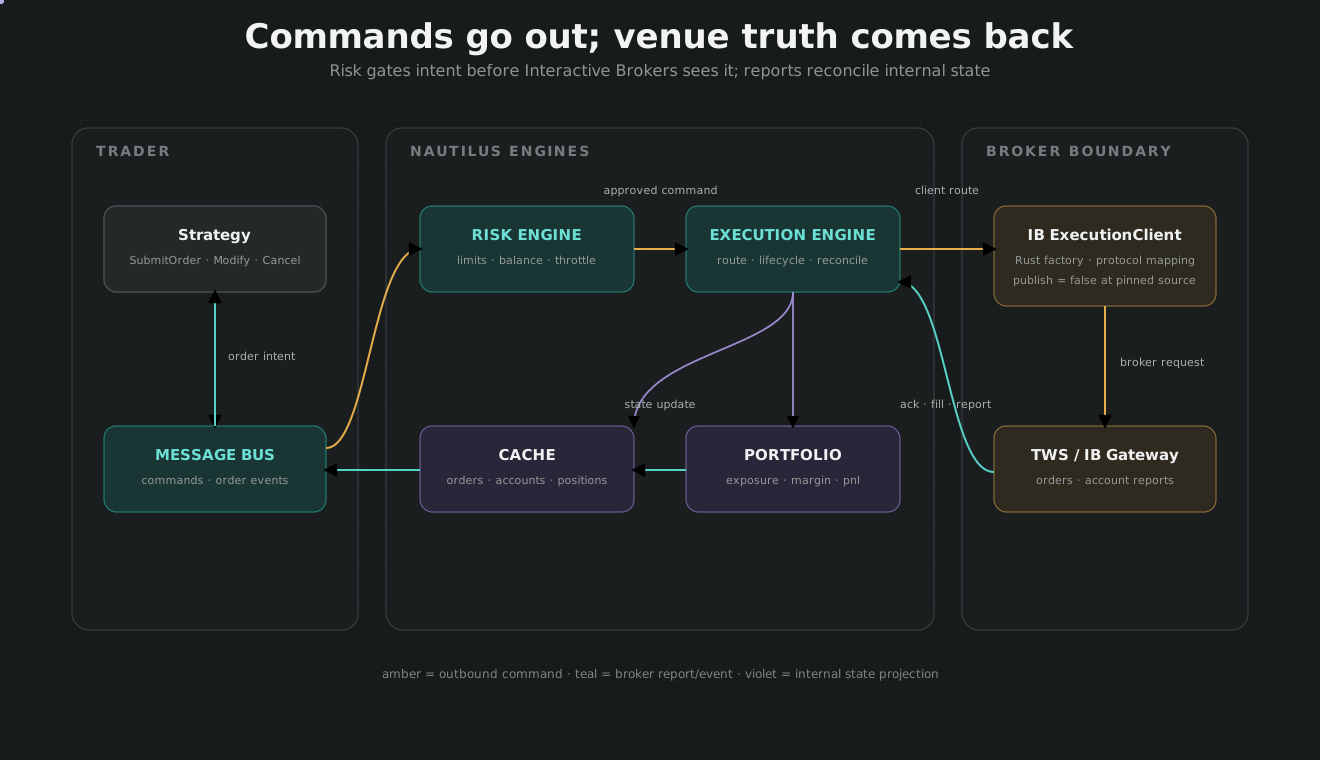
Execution Pipeline
The sequence of events from a strategy issuing a SubmitOrder command to the final OrderFilled event.
Order Execution Data Flow
Event Sourcing & Event Store
EventStore
The durable authority for state-affecting history. It captures commands, events, and venue reports flowing across the MessageBus.
- BusCaptureAdapter: Subscribes to the bus and forwards messages to the
EventStoreWriter - RedbBackend: An embedded key-value store used for high-performance local persistence
- Sequence (seq): A monotonically increasing identifier for every entry in the store, providing total ordering.
- Run & Entry: A "run" represents a single execution lifecycle (start to stop). An "entry" is a single serialized message with metadata
- High-watermark: The highest sequence number successfully persisted to the backend.
- Verifier: A utility to check the integrity of the event store, identifying gaps or index drift
- Format Change: The
event_storeformat was updated in v1.230, requiring regeneration of old stores
Technical abbreviations and selected-adapter jargon
| Abbreviation | Full Term | Context | Code Pointer |
|---|---|---|---|
| FFI | Foreign Function Interface | Optional ABI boundary outside the native Rust API documented in this edition. | |
| DBN | Databento Binary Encoding | High-performance market data format. | |
| PnL | Profit and Loss | Portfolio performance tracking. | |
| MSRV | Minimum Supported Rust Version | Build system requirement (1.97.0 at the pinned revision). | |
| DST | Deterministic Simulation Testing | Validation of system state under simulation. | |
| ABI | Application Binary Interface | Versioning for the plugin system to ensure host/plugin compatibility. |
bon::Builder Config Pattern
A Rust crate (bon) used for generating type-safe, ergonomic builders for complex configuration objects.
- Implementation: Used extensively for configuration design where
Optionmeans semantic absence and strict unknown-field rejection is enforced
RecordFlag (F_LAST / F_SNAPSHOT)
Flags used in data streams to signal event boundaries and snapshot state.
F_LAST: Marks the final delta in a logical groupF_SNAPSHOT: Marks deltas belonging to a full book snapshot
Plugin System
The nautilus-plugin crate allows loading separately compiled Rust shared libraries (cdylibs) at runtime.
- PluginManifest: Defines the metadata and entry points for a plugin.
- ABI Versioning: Hardened to reject manifest ABI mismatches