Rust edition: this page follows the live DeepWiki structure but treats the current Rust crates as implementation authority. Non-Rust surfaces are identified at their boundary and are not presented as Rust APIs.
Cache and State Management
Relevant Rust source files
crates/common/src/cache/mod.rscrates/infrastructure/src/redis/cache.rscrates/infrastructure/src/sql/cache.rs
The Cache is the central in-memory database for all trading system state. It stores instruments, orders, positions, accounts, and market data in indexed structures for fast O(1) lookups. User code accesses the cache through a read-only CacheFacade, while system engines have full read/write access. The cache can optionally persist state to Redis or PostgreSQL for recovery across restarts.
This page documents:
- Cache architecture and component responsibilities.
- Initialization and database backing configuration.
- State persistence and recovery mechanisms.
- Integration patterns with system engines.
- Query methods and access patterns.
Cache Architecture
The Rust cache subsystem provides fast in-memory state, secondary indexes, and an optional CacheDatabaseAdapter durability boundary.
Cache Architecture Diagram
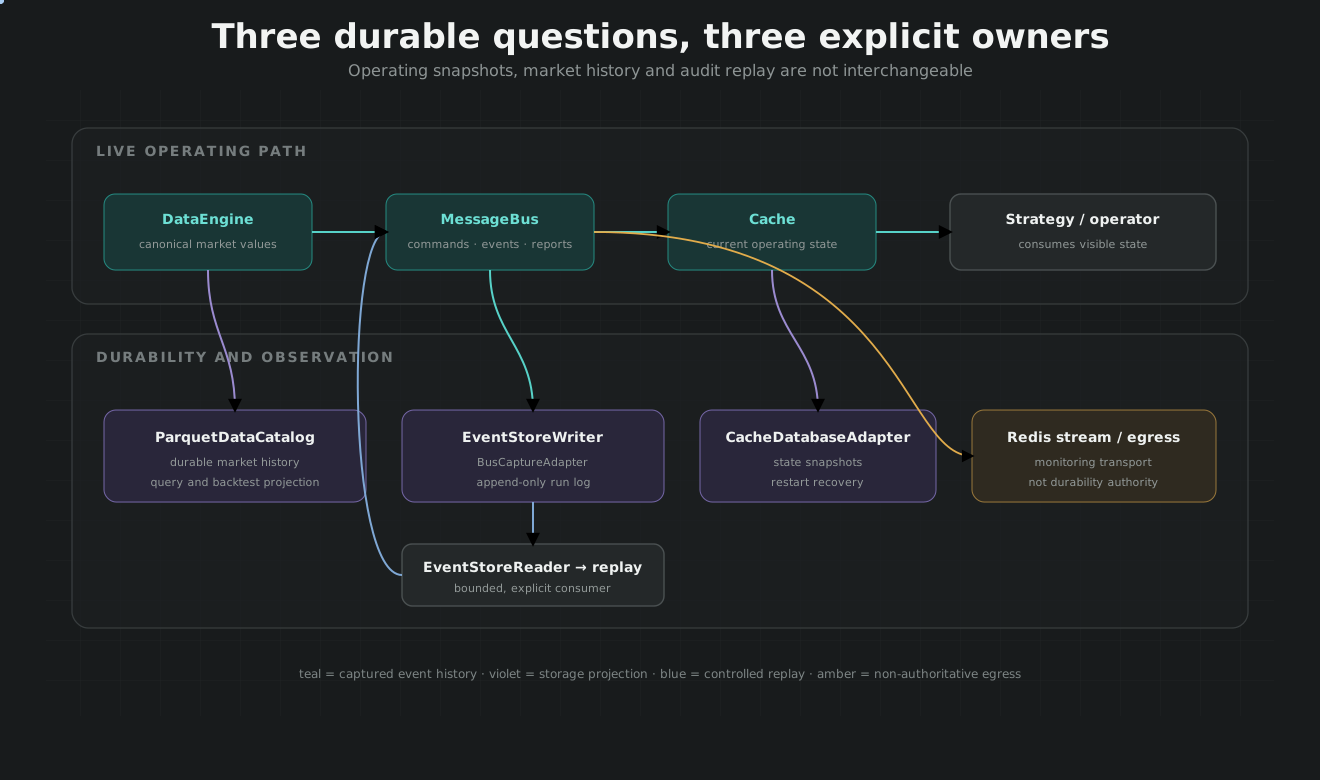
Component responsibilities:
Cache( ): Full read/write interface for storing and retrieving all trading state. It maintains in-memory dictionaries (orAHashMapin Rust) indexed by various keys for fast O(1) lookups.CacheFacade( ): Read-only wrapper aroundCacheexposed to user code (strategies/actors) preventing accidental state modification.CacheDatabaseAdapter( ): Bridges theCacheto persistent storage. It handles serialization and routes operations to specific database implementations.RedisCacheDatabase( ): High-performance Redis implementation using an asynchronous write task to avoid blocking the main trading loop.SQL Persistence( ): Provides relational backing via PostgreSQL, including complex schema support for orders, positions, and accounts.
Core Cache Implementation
The Cache maintains multiple internal data structures to provide comprehensive state management.
Internal Storage Structures
The following tables describe the primary storage dictionaries maintained within the Cache class
| Storage Member (Py) | Storage Member (RS) | Key Type | Value Type | Description |
|---|---|---|---|---|
_instruments |
instruments |
InstrumentId |
Instrument |
Trading instrument definitions. |
_orders |
orders |
ClientOrderId |
Order |
All orders indexed by client ID. |
_positions |
positions |
PositionId |
Position |
Open and closed positions. |
_accounts |
accounts |
AccountId |
Account |
Balances and margin state. |
_quote_ticks |
quotes |
InstrumentId |
VecDeque[QuoteTick] |
FIFO buffer of recent quotes. |
_trade_ticks |
trades |
InstrumentId |
VecDeque[TradeTick] |
FIFO buffer of recent trades. |
_bars |
bars |
BarType |
VecDeque[Bar] |
FIFO buffer of recent OHLCV bars. |
_order_books |
books |
InstrumentId |
OrderBook |
Current L1/L2/L3 market depth. |
Indexing and Fast Lookups
To support queries without full scans, the Rust cache maintains secondary indexes through CacheIndex and the collections owned by Cache:
_index_venue_orders: Maps aVenueto a set ofClientOrderId._index_venue_order_ids: Maps aVenueOrderId(from the exchange) to the internalClientOrderId._index_order_position: Maps aClientOrderIdto thePositionIdit belongs to._index_strategy_positions: Maps aStrategyIdto its associatedPositionIdset.
Persistence and Database Backing
NautilusTrader supports optional persistent backing to allow state recovery after a system restart. This is critical for live trading.
Redis Implementation Architecture
The RedisCacheDatabase in Rust uses a dual-connection architecture to maximize performance :
- READ Connection (
self.con): Synchronous queries (keys,read,load_all) for loading state during startup. - WRITE Connection: Managed by a background task on the Nautilus runtime. Write operations (
insert,update,delete,flush) are sent via an unboundedtokio::sync::mpscchannel
Redis Persistence Flow
PostgreSQL Support
The system also supports PostgreSQL via CachePostgresAdapter. The schema includes specialized tables for accounts, instruments, orders, and positions This implementation is used for robust, transactional state persistence and is supported by the Nautilus CLI for database management.
Query Interface and Facade
The CacheFacade provides the public API for strategies and actors. It ensures that user-level components cannot modify the global state directly.
Key Query Methods
The Cache implementation (and its facade) provides comprehensive methods for retrieving state :
-
Market Data:
quote_tick(instrument_id, index=0): Returns the Nth most recent quote.bars(bar_type): Returns the full list of cached bars for a type.price(instrument_id, price_type): Returns the latest price (Bid, Ask, Last, etc.).
-
Execution State:
orders_open(strategy_id=...): Returns all currently active orders for a strategy.positions_open(instrument_id=...): Returns all open positions for an instrument.account(account_id): Returns the current balance and margin for an account.
Memory Management
The cache prevents memory exhaustion through configurable capacities :
tick_capacity: Limits the number of ticks stored per instrument.bar_capacity: Limits the number of bars stored per bar type. When capacity is reached, the oldest data is evicted from the internal storage (FIFO behavior).
State Recovery Workflow
State recovery is triggered during system initialization if a database is configured.
Code Entity Space: Recovery Flow
Trader.load(): Orchestrates the loading of all system components.Cache.cache_all(): Triggers loading of all categories (Instruments, Orders, Positions, Accounts)CacheDatabaseAdapter.load(): Uses the configuredSerializerto turn database bytes back into Rust objectsCache.build_index(): Reconstructs the secondary indexes (like_index_venue_orders) from the loaded primary data