Rust edition: this page follows the live DeepWiki structure but treats the current Rust crates as implementation authority. Non-Rust surfaces are identified at their boundary and are not presented as Rust APIs.
Actors and Component Lifecycle
Relevant Rust source files
crates/common/src/actor/data_actor.rs
Overview
This page documents the Actor base class, which serves as the foundation for custom data-processing components in NautilusTrader. Actors consume market data, process events, register indicators, and maintain state without submitting orders or managing positions. They are fundamental building blocks within the data system for analysis, signal generation, and system monitoring.
Scope:
Actorclass structure and initialization viaregister_base()- Component lifecycle states and transition methods (
on_start,on_stop, etc.) - Event handler methods (
on_quote_tick,on_bar,on_data, etc.) - Data subscription and request patterns
- Indicator registration and automatic updates
- State persistence with
on_save()andon_load() - Signal publishing for inter-component communication
- Rust-native
DataActorimplementation andDataEngineinteraction - How to write Rust actors using the
nautilus_actor!macro andDataActorCore.
Related pages:
- Component state machine fundamentals:
- Data routing and engine orchestration:
- Trading strategies with order management:
Actor Base Class
The Actor class is defined in and inherits from Component, providing event-driven data processing without order management capabilities.
Key characteristics:
| Feature | Description |
|---|---|
| Event-driven | Responds to market data via handler methods (on_quote_tick, on_bar, etc.) |
| Non-trading | Does not submit orders; use Strategy for trading logic |
| Stateful | Supports state persistence via on_save() and on_load() |
| Data consumer | Subscribes to instruments, ticks, bars, order books, custom data |
| Concurrent | Supports async task execution through ActorExecutor |
Common use cases:
- Market data analysis and signal generation
- Custom indicator calculations
- System health monitoring
- Data recording and archival
- Inter-component signaling
Class Hierarchy and Dependencies
Inheritance hierarchy:
DataActor and Strategy build on shared component lifecycle and actor contracts; strategy adds order and portfolio behavior while data actors remain focused on subscriptions, requests and custom data processing.
Actor dependencies and interfaces:
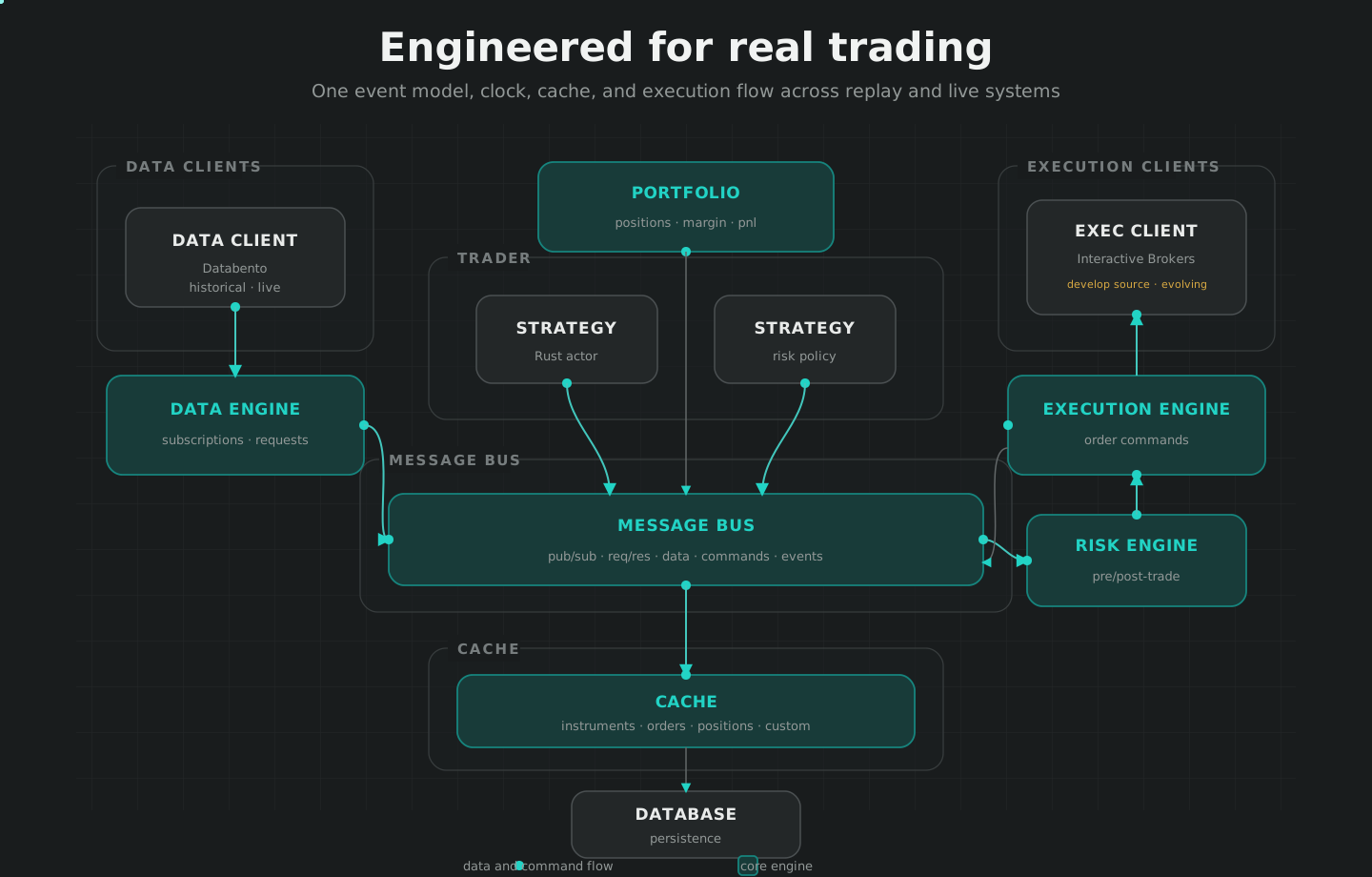
Key fields initialized via register_base():
| Field | Type | Source |
|---|---|---|
msgbus |
MessageBus |
|
cache |
CacheFacade |
|
clock |
Clock |
|
portfolio |
PortfolioFacade |
|
greeks |
GreeksCalculator |
Registration and Initialization
Actors must be registered with the system before use. Registration connects the actor to core services and transitions it from PRE_INITIALIZED to READY state.
Registration Process
Component Lifecycle States
Actors inherit the Component lifecycle state machine. Key states relevant to actor operation:
Primary states:
| State | Transition | Description |
|---|---|---|
PRE_INITIALIZED |
__init__() |
Actor constructed, not yet registered |
READY |
register_base() |
Registered with system, ready to start |
RUNNING |
start() |
Processing events and data |
STOPPED |
stop() |
Paused, can resume or reset |
DISPOSED |
dispose() |
Permanently shut down |
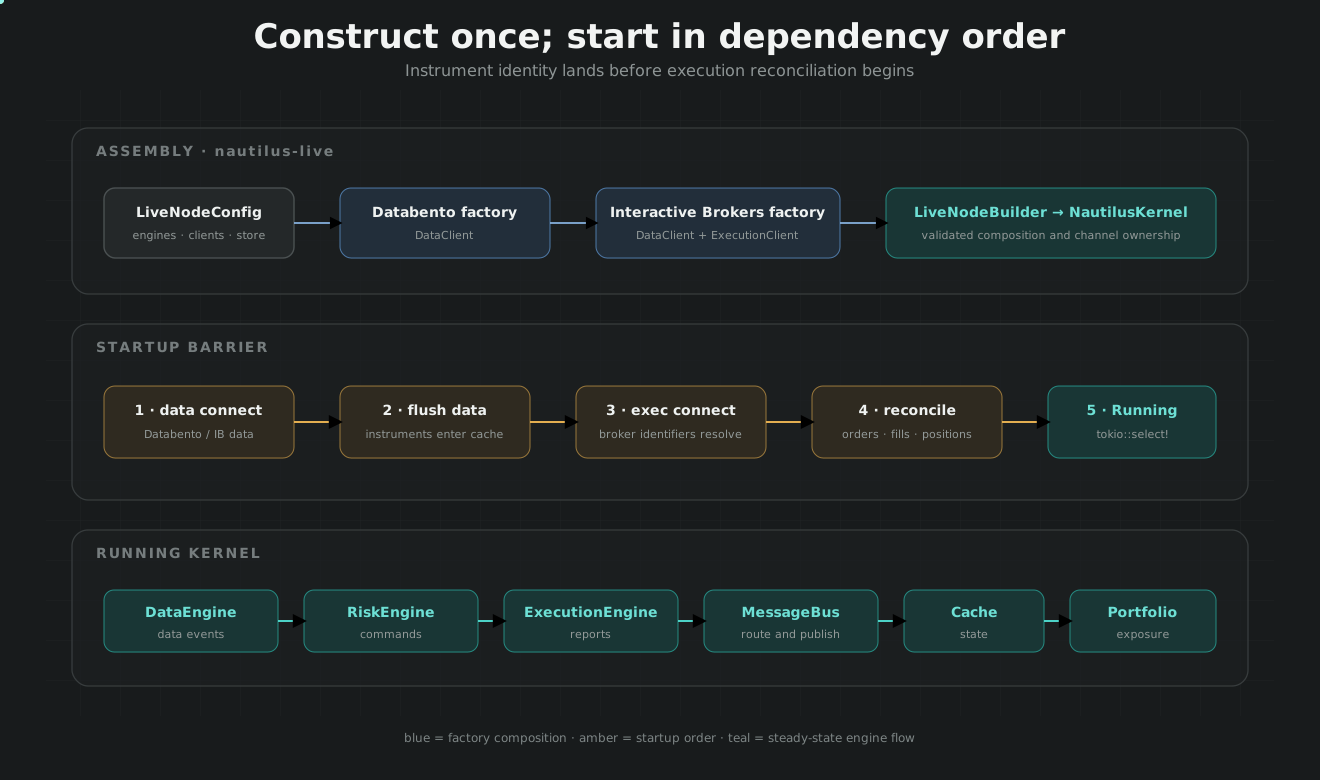
State transitions for actors:
Lifecycle Methods
Actors override lifecycle methods defined in to control initialization and cleanup.
Core lifecycle methods:
| Method | Called During | Typical Use |
|---|---|---|
on_start() |
READY → RUNNING |
Subscribe to data, initialize resources |
on_stop() |
RUNNING → STOPPED |
Pause processing, log status |
on_resume() |
STOPPED → RUNNING |
Resume after pause |
on_reset() |
→ READY |
Clear state, reset indicators |
on_dispose() |
→ DISPOSED |
Release resources |
on_save() |
System shutdown | Return state for persistence |
on_load() |
System startup | Restore from persistence |
Event Handler Methods
Actors implement event handlers defined in to receive market data.
Market data handlers:
| Handler Method | Data Type | Source |
|---|---|---|
on_quote_tick(tick) |
QuoteTick |
|
on_trade_tick(tick) |
TradeTick |
|
on_bar(bar) |
Bar |
|
on_order_book(book) |
OrderBook |
|
on_order_book_deltas(deltas) |
OrderBookDeltas |
|
on_instrument(instrument) |
Instrument |
Derivative data handlers:
| Handler Method | Data Type | Source |
|---|---|---|
on_mark_price(update) |
MarkPriceUpdate |
|
on_index_price(update) |
IndexPriceUpdate |
|
on_funding_rate(update) |
FundingRateUpdate |
Data Subscription and Requests
Actors manage data flow via subscription and request commands routed through the DataEngine.
Subscription Methods
subscribe_quote_ticks(instrument_id): Subscribes to BBO updatessubscribe_trade_ticks(instrument_id): Subscribes to trade execution updatessubscribe_bars(bar_type): Subscribes to aggregated barssubscribe_order_book(instrument_id): Subscribes to full L2/L3 order book updates
Request Methods
request_quote_ticks(instrument_id, start, end): Requests historical quote datarequest_trade_ticks(instrument_id, start, end): Requests historical trade datarequest_bars(bar_type, start, end): Requests historical bar datarequest_order_book_snapshot(instrument_id): Requests current order book state
Indicator Registration
Indicators can be registered to receive automatic updates before actor handlers are called.
Registration methods:
register_indicator_for_quote_ticks(instrument_id, indicator):register_indicator_for_trade_ticks(instrument_id, indicator):register_indicator_for_bars(bar_type, indicator):
Update flow:
- Market data arrives via
MessageBus. Actor.handle_quote_tick(or similar) is called- Registered indicators for that instrument/type are updated
- The user-defined
on_quote_tick(or similar) is called
DataActor (Rust)
The DataActor trait and DataActorCore provide a high-performance Rust implementation for actors.
DataActor Trait
The Rust DataActor trait provides lifecycle and market-data callbacks such as on_start, on_quote, on_trade, and on_bar.
DataActorCore
DataActorCore is the foundational struct for Rust actors, managing common actor functionalities such as logging, message bus interaction, cache access, and request handling It is embedded within any concrete Rust actor implementation.
Writing Rust Actors with nautilus_actor!
The nautilus_actor! macro simplifies the creation of Rust actors by automatically implementing the Component and DataActor traits, and providing the necessary Deref and DerefMut implementations to access DataActorCore
Example:
#[derive(Debug)]
struct TestDataActor {
    core: DataActorCore,
    pub received_time_events: Vec<TimeEvent>,
    // ... other fields
}

nautilus_actor!(TestDataActor); // This macro implements the necessary traits

impl DataActor for TestDataActor {
    fn on_start(&mut self) -> anyhow::Result<()> {
        log::info!("Starting actor");
        Ok(())
    }
    // ... implement other on_* methods
}
This macro allows TestDataActor to behave as a DataActor and Component, delegating core functionalities to its core field.
Deferred Commands
The Rust DataEngine supports DeferredCommand objects (Subscribe, Unsubscribe, etc.) pushed to a DeferredCommandQueue by components like handlers or timers that lack direct client access These commands are processed by the DataEngine loop.
Rust DataEngine Handlers
The DataEngine in Rust uses specialized handlers for various aggregation tasks:
BarBarHandler: Handles bar-to-bar aggregationBarTradeHandler: Handles trade-to-bar aggregationBarQuoteHandler: Handles quote-to-bar aggregationSpreadQuoteHandler: Handles aggregation of spread quotes
Summary of Interaction Patterns
Actors receive lifecycle and data callbacks through the component and message-bus contracts. Registration establishes the subscriptions and indicators an actor owns; startup activates them; deferred commands safely cross into the data-engine loop; and stop/dispose removes those resources in dependency order. Rust actors should keep domain work inside typed callbacks and leave provider networking, persistence, and node orchestration to their owning adapters and services.