Rust edition: this page follows the live DeepWiki structure but treats the current Rust crates as implementation authority. Non-Rust surfaces are identified at their boundary and are not presented as Rust APIs.
Order Types and Lifecycle
Relevant Rust source files
crates/model/src/orders/mod.rscrates/model/src/orders/any.rscrates/model/src/orders/builder.rscrates/model/src/events/order/mod.rscrates/model/src/enums.rs
This page documents the order types supported by NautilusTrader, their lifecycle through the system, and the event-driven flow from order submission to fill. It covers the order state machine, available execution instructions, and how orders interact with the execution and risk engines.
Order Type Overview
NautilusTrader supports a comprehensive set of order types, defined by the OrderType enum. All order types derive from a core model structure, implemented in both Rust and legacy bindings Specific implementations provide specialized logic for price and trigger handling.
| Order Type | Class | Description |
|---|---|---|
MARKET |
MarketOrder |
Executes immediately at best available price |
LIMIT |
LimitOrder |
Rests at specified price or better until matched |
STOP_MARKET |
StopMarketOrder |
Becomes market order when stop price triggered |
STOP_LIMIT |
StopLimitOrder |
Becomes limit order when stop price triggered |
MARKET_TO_LIMIT |
MarketToLimitOrder |
Market order that converts unfilled quantity to limit |
MARKET_IF_TOUCHED |
MarketIfTouchedOrder |
Becomes market order when trigger price reached |
LIMIT_IF_TOUCHED |
LimitIfTouchedOrder |
Becomes limit order when trigger price reached |
TRAILING_STOP_MARKET |
TrailingStopMarketOrder |
Stop that trails price by a fixed or percentage offset |
TRAILING_STOP_LIMIT |
TrailingStopLimitOrder |
Stop-limit that trails price by offset |
Nautilus categorizes these types for internal routing and validation logic:
- STOP_ORDER_TYPES: Orders with stop or trigger prices
- LIMIT_ORDER_TYPES: Orders that specify a limit price
- TRIGGERABLE_ORDER_TYPES: Orders that support an intermediate
TRIGGEREDstatus
Order State Machine
Rust orders progress through validated state transitions governed by OrderStatus and the concrete order/event logic in nautilus-model.
Transition Logic
Transitions are triggered by OrderEvent subclasses. The state machine ensures that an order cannot move to an invalid state (e.g., from FILLED back to ACCEPTED).
State Definitions
| Status | Category | Description |
|---|---|---|
INITIALIZED |
Local | Order created via OrderInitialized seed event |
EMULATED |
Local | Held by OrderEmulator for local triggering |
SUBMITTED |
In-Flight | Sent to execution client, awaiting venue response |
ACCEPTED |
Open | Confirmed by venue, working in the book |
FILLED |
Terminal | Completely executed |
DENIED |
Terminal | Rejected by local RiskEngine |
Order Event Flow
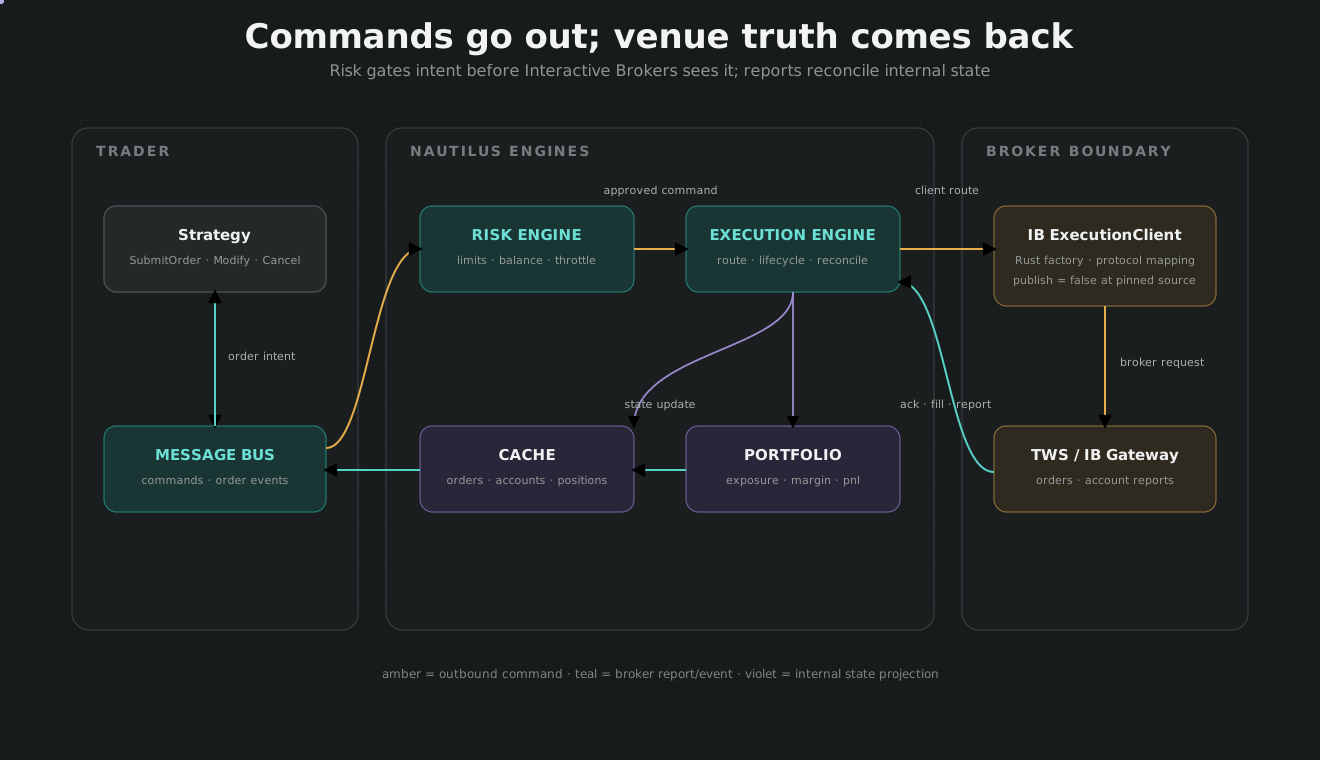
The system uses an event-driven architecture where components communicate via a MessageBus. The ExecutionEngine orchestrates the lifecycle by updating order state and routing commands.
Submission to Fill Sequence
The following diagram maps the logical flow to specific code entities involved in the lifecycle.
A limit-order lifecycle begins with canonical order construction, becomes a SubmitOrder command, passes risk checks, reaches the selected execution client, and advances only when venue reports are applied by ExecutionEngine.
Execution Instructions and Time in Force
Time in Force (TIF)
NautilusTrader supports standard TIF values defined in TimeInForce :
GTC: Good 'til Canceled.IOC: Immediate or Cancel.FOK: Fill or Kill.GTD: Good 'til Date (requiresexpire_time).DAY: Valid until the end of the trading day.AT_THE_OPEN/AT_THE_CLOSE: Auction-specific instructions.
Execution Flags
post_only: Ensures the order only provides liquidity; it will be rejected or canceled if it would cross the spreadreduce_only: Ensures the order only reduces or closes an existing positiondisplay_qty: Used for iceberg orders to specify the visible quantity on the public order bookemulation_trigger: Defines the market price trigger for local order emulation (e.g.,BID_ASK,LAST)
Position Integration
When an OrderFilled event occurs, the system updates the corresponding Order state, tracking filled_qty, leaves_qty, and avg_px
OrderAny is the sum type over concrete order implementations such as market, limit, stop-market, stop-limit, market-to-limit, trailing-stop, market-if-touched and limit-if-touched orders. Execution logic matches variants without erasing their invariants.
The Order base class maintains a history of events venue order IDs and trade IDs associated with its lifecycle.