Rust edition: this page follows the live DeepWiki structure but treats the current Rust crates as implementation authority. Non-Rust surfaces are identified at their boundary and are not presented as Rust APIs.
Account Management
Relevant Rust source files
crates/model/src/accounts/mod.rscrates/model/src/accounts/cash.rscrates/model/src/accounts/margin.rscrates/portfolio/src/portfolio.rs
NautilusTrader's account management system tracks trading account state across different venue types and account models. This includes balance tracking, margin calculations, leverage configuration, and account event handling from both live and simulated venues.
This page explains:
- Account types (
CashAccount,MarginAccount, andBettingAccount) - Account state representation via
AccountStateevents - Balance tracking (total, free, locked)
- Margin calculations and leverage management
- The
AccountsManagerand its role in the system
Account Type Hierarchy
NautilusTrader supports three specialized account types, each inheriting from a base Account class to handle specific balance management and risk characteristics.
| Account Type | Class | Use Cases | Leverage |
|---|---|---|---|
CASH |
CashAccount |
Spot trading, non-leveraged positions | No (1.0x) |
MARGIN |
MarginAccount |
Futures, perpetuals, leveraged spot | Yes |
BETTING |
BettingAccount |
Sports betting, prediction markets | No |
Code Entity Mapping: Account Models
The following diagram bridges the natural language concepts of account types to their specific implementation classes and identifiers across the Rust layers.
Diagram — Account Entity Mapping
Account State and Balance Tracking
AccountState Event
The AccountState object is the primary data structure for conveying account snapshots across the system. It is generated by the AccountsManager or execution clients.
| Field | Type | Description |
|---|---|---|
account_id |
AccountId |
Unique identifier for the account. |
balances |
list[AccountBalance] |
List of total, locked, and free amounts per currency. |
margins |
list[MarginBalance] |
Initial and maintenance requirements (Margin only). |
reported |
bool |
True if the state was reported by an external venue. |
Balance Types
Accounts maintain three distinct balance metrics for every held currency:
- Total: The absolute amount of currency held.
- Locked: Capital reserved for open orders or as margin for open positions.
- Free: Capital available for new trades (
Total - Locked).
In a CashAccount, submitting a BUY order locks the quote currency (cost + fees), while a SELL order locks the base currency (the asset being sold) If total locked exceeds total balance due to latency, the account clamps locked to total to avoid crashes
Margin and Leverage Management
MarginAccount allows for leveraged trading by tracking instrument-specific requirements and supporting both isolated and cross-margin modes.
Leverage Configuration
Leverage can be set globally for the account or overridden for specific instruments.
set_default_leverage(leverage): Sets the fallback leverageset_leverage(instrument_id, leverage): Overrides leverage for a specific asset
Cross-Margin and Per-Currency Queries
NautilusTrader supports account-wide (cross-margin) requirements, often used in crypto derivatives.
account_margins(): Returns cross-margin balances keyed by collateral currencymargins(): Returns per-instrument (isolated) margin balances
Margin Calculations
The MarginAccount uses a MarginModel (defaulting to LeveragedMarginModel) to calculate requirements
Diagram — Margin Calculation Flow
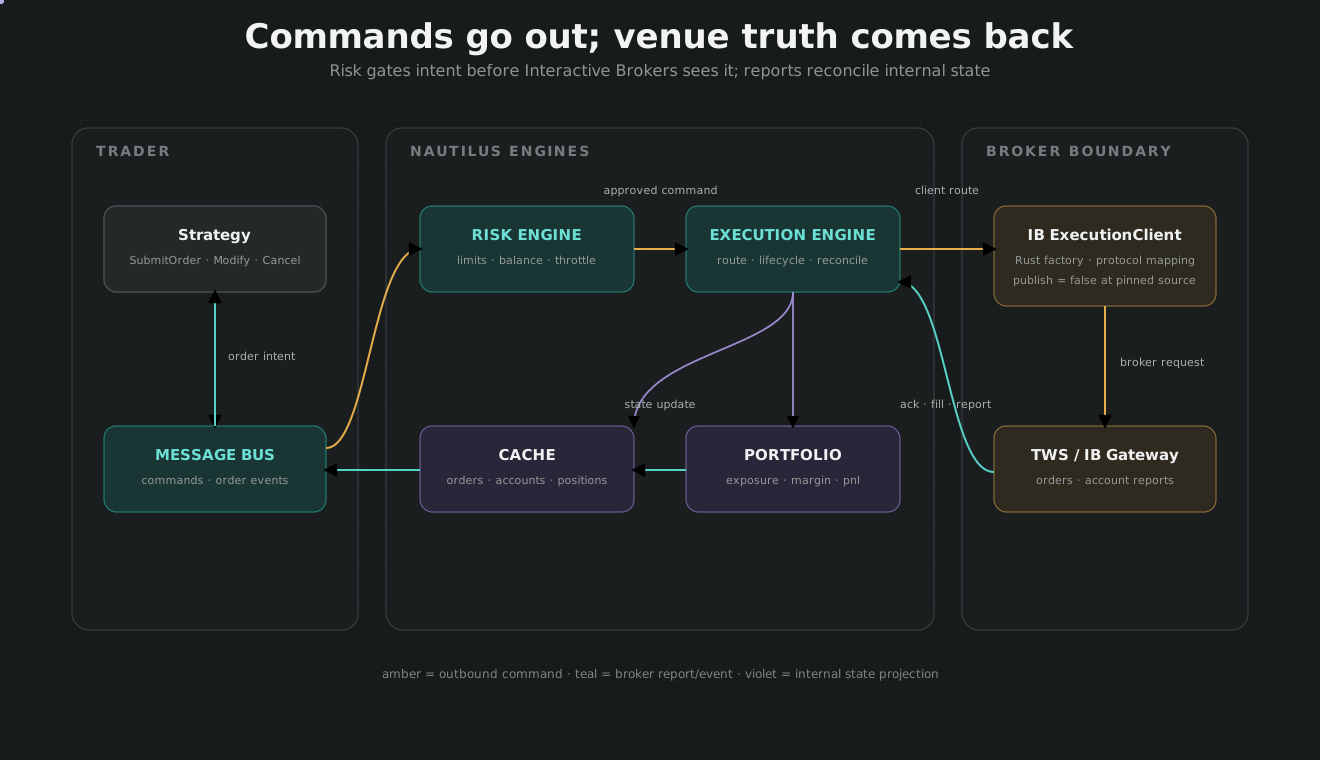
An OrderFilled event and its canonical instrument and position identity drive account balance, PnL, and margin-model calculations. The resulting AccountState and margin balances are internal projections of the accepted venue event, not provider-specific objects.
Account Event Handling
Account management is orchestrated by the AccountsManager, which coordinates state updates between the Cache and the individual Account objects.
The AccountsManager
The AccountsManager is responsible for:
- Updating Balances: Processing
OrderFilledevents to adjust cash and margin - State Generation: Creating
AccountStatesnapshots for the rest of the system - Order Updates: Locking or unlocking balances as orders are created or canceled
Data Flow: Fill to Balance Update
When an order is filled, the following flow occurs:
- An
OrderFilledevent is received by the system. AccountsManager.update_balancesis called with the fill event- The manager retrieves the associated
Positionfrom theCache - The specific
Account(Cash or Margin) calculates PnL viacalculate_pnls - Balances are updated for either single-currency or multi-currency configurations
Betting Accounts
The BettingAccount is a specialized version of a CashAccount used for betting exchanges like Betfair. It enforces AccountType.CASH internally while specialized for betting logic
- Stake Locking: Instead of locking base/quote currency, it manages locks specific to betting stakes.
- PnL: Calculated based on the outcome of the betting market rather than standard security price movement.
Precision and Portfolio Integration
All accounting in NautilusTrader uses fixed-point arithmetic via the Money, Price, and Quantity classes to avoid floating-point errors.
Portfolio State Synchronization
The Portfolio component uses AccountsManager to maintain its internal state.
Portfoliocontains anAccountsManagerinstance- It registers handlers for
AccountStateevents to update the portfolio's view of balances - The
PortfolioAnalyzeruses these balances to calculate statistics like Sharpe Ratio and Profit Factor