Rust edition: this page follows the live DeepWiki structure but treats the current Rust crates as implementation authority. Non-Rust surfaces are identified at their boundary and are not presented as Rust APIs.
Clock System and Time Management
Relevant Rust source files
crates/common/src/clock.rscrates/common/src/live/clock.rscrates/system/src/clock_factory.rscrates/core/src/nanos.rs
This document describes the clock system and time management infrastructure in NautilusTrader. The clock system provides unified time interfaces for both backtesting (deterministic time) and live trading (real-time), supporting nanosecond precision timestamps and flexible timer callback mechanisms.
Purpose and Scope
The clock system serves two critical functions:
- Time source abstraction: Provides a unified API for obtaining current time across backtest and live contexts via the
Clocktrait - Timer management: Enables components to schedule future callbacks via time alerts and repeating timers
The system ensures that strategies and components can use identical time-related code in both backtesting (with manually controlled time) and live trading (with real system time), maintaining the platform's core principle of research-to-production parity.
Clock Type Hierarchy
NautilusTrader implements two concrete Rust clock types behind the common Clock trait: deterministic TestClock and real-time LiveClock.
Entity Relationship Diagram
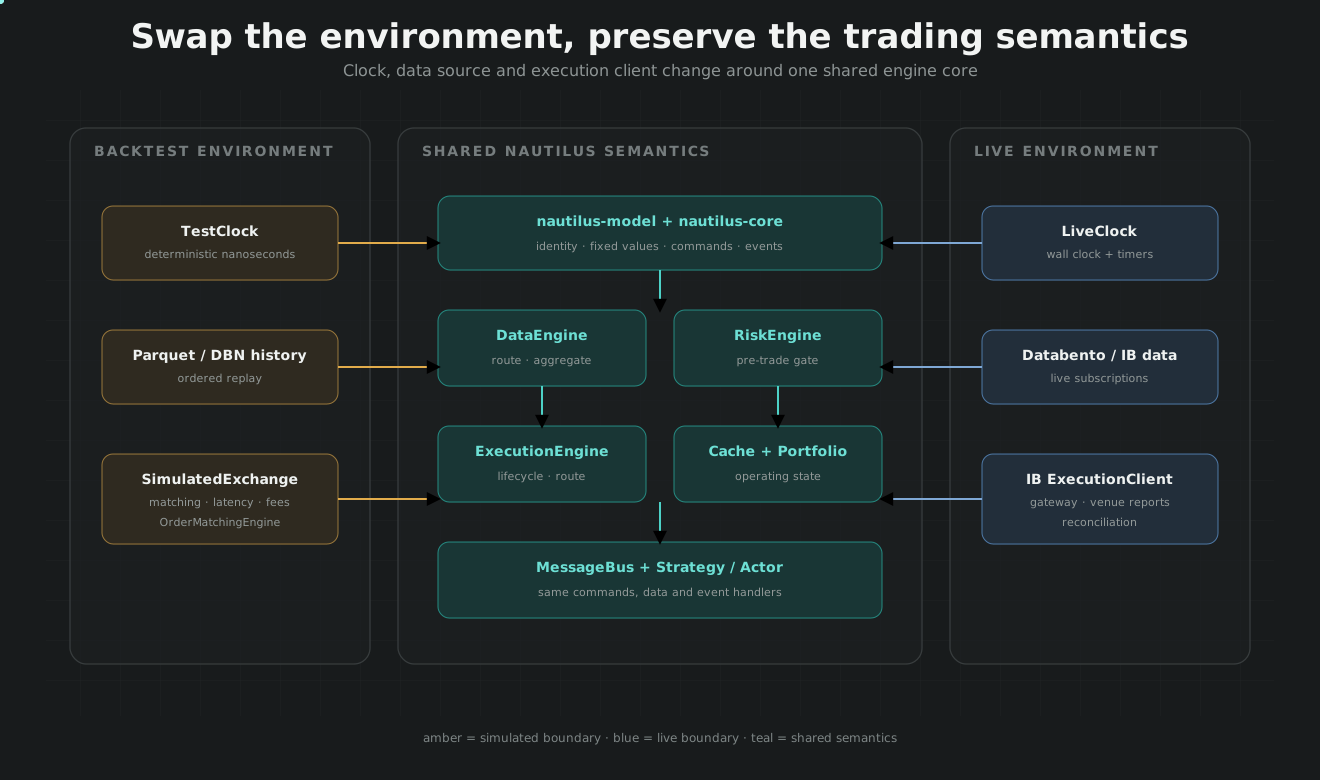
Both clocks implement timestamp, UTC, timer enumeration, time-alert, repeating-timer, cancellation, and default-handler operations. TestClock additionally exposes controlled time advancement for deterministic simulation; LiveClock advances from the system clock and dispatches real-time timers.
Base Clock Interface
The Clock trait defines the common interface for all clock implementations
Timestamp Methods
All clocks provide multiple timestamp precision levels, derived from a 64-bit nanosecond integer wrapped in the UnixNanos type:
| Method | Return Type | Description | Precision |
|---|---|---|---|
timestamp() |
f64 |
UNIX timestamp in seconds | Floating point |
timestamp_ms() |
u64 |
UNIX timestamp in milliseconds | 1 millisecond |
timestamp_us() |
u64 |
UNIX timestamp in microseconds | 1 microsecond |
timestamp_ns() |
UnixNanos |
UNIX timestamp in nanoseconds | 1 nanosecond |
AtomicTime and Monotonicity
The system uses AtomicTime to manage thread-safe time updates.
- Real-time mode: Uses atomic operations to ensure strictly increasing timestamps even if the system clock drifts.
- Static mode: Uses acquire/release semantics for manual updates in simulations via
set_timeorincrement_time
TestClock: Deterministic Time for Backtesting
The TestClock provides a static, manually controlled clock for backtesting and unit testing. It only advances when explicitly instructed
Key Characteristics
- Deterministic: Time only advances via explicit calls like
set_timeorincrement_time - Priority Queue: Uses a
BTreeMapto manage scheduled events by timestamp, ensuring they fire in the correct order - Synchronous Execution: Callbacks in
TestClockare executed synchronously during the time advancement phase as the clock reaches scheduled event times.
LiveClock: Real-Time for Live Trading
The LiveClock uses system time to provide real-time timestamps for live trading environments
Key Characteristics
- System Time Based: Queries the actual system clock.
- Monotonic Guarantees: Timestamps are guaranteed to be unique and monotonically increasing.
- Asynchronous Timers: Schedules alerts that fire based on real-world elapsed time using the system's asynchronous event loop.
Timer System
Both clock types support scheduling future callbacks via TimeEventCallback
Callback Types
NautilusTrader supports multiple callback execution contexts :
Callback: Executes a registered Rust callback through the clock callback registry.Rust: Thread-safe callbacks (Send + Sync) usingArcRustLocal: Single-threaded callbacks usingRcfor capturing local state likeRefCell
Time Alerts and Repeating Timers
- Time Alerts: A one-time event scheduled for a specific timestamp via
set_time_alert_ns - Repeating Timers: An event that fires at regular intervals via
set_timer_ns
TimeEvent Structure
When a timer fires, it produces a TimeEvent :
name: Identifier of the timer (as aUstr)event_id: UniqueUUID4for the eventts_event: The scheduled execution time (UnixNanos)ts_init: The actual creation time of the event instance
Throttler and Rate Limiting
The Throttler component controls the rate of message processing to prevent venue rate-limit breaches or system overload
Throttler Logic
- RateLimit: Defines a
limit(count) and aninterval_ns(nanoseconds) - Buffering: If the limit is reached, messages are stored in a
VecDeque<T>buffer - Leaky Bucket: It tracks message timestamps in a
VecDeque<UnixNanos>to enforce the sliding window - Integration: Used extensively in the
RiskEngineto throttle order submissions and modifications
Builder Patterns and Factories
For live and sandbox nodes, the system provides builder methods to inject the appropriate clock implementation.
with_clock_factory
The with_clock_factory pattern is used in node builders (like LiveNode or SandboxNode) to allow the system to instantiate the correct Clock type during the initialization phase. This ensures that even when running in a "sandbox" (live components with a test clock), the dependency injection is handled correctly.
Summary Table: Time Constants
The system defines standard nanosecond-based constants for calculations.
| Constant | Value (Nanoseconds) |
|---|---|
NANOSECONDS_IN_MICROSECOND |
1,000 |
NANOSECONDS_IN_MILLISECOND |
1,000,000 |
NANOSECONDS_IN_SECOND |
1,000,000,000 |
NANOSECONDS_IN_MINUTE |
60,000,000,000 |
NANOSECONDS_IN_DAY |
86,400,000,000,000 |